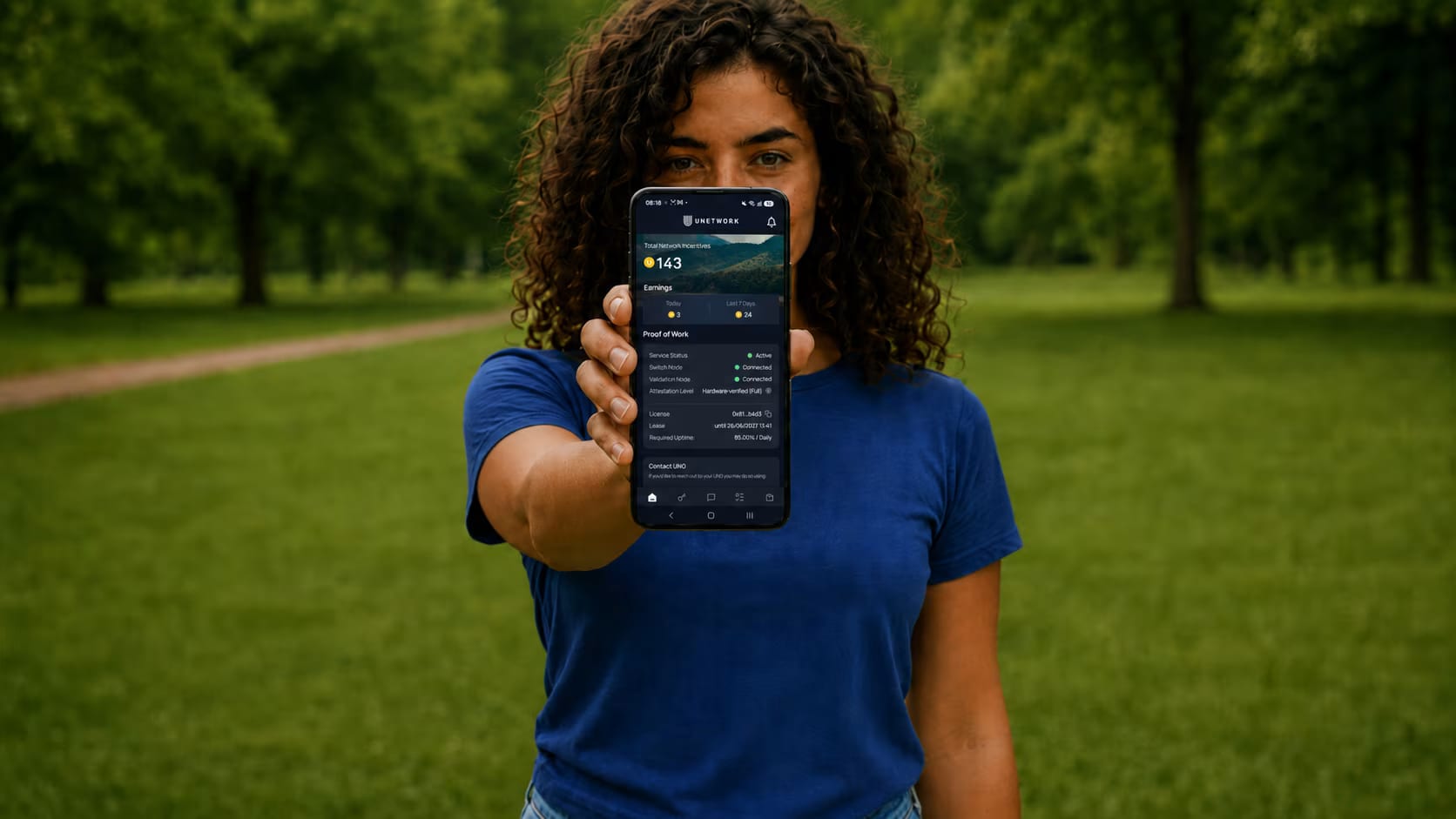
License code
Unetwork operator guide
Get rewarded by connecting your phone to Unetwork
Unetwork app turns your network data into rewards automatically.
Your Unetwork License
Get a Unetwork App license code in one tap.
Get the best split available. Copy it into the Unetwork App to activate your license.
- 1
Install
Download the Unetwork App.
- 2
Claim
Get the best available license code.
- 3
Connect
Keep the app online for eligible tasks.
Live reward split
Available Now--%
To you
--%
To node operator
YouNode operator
Checking the best available split.
Preparing the security check for license codes.
Unetwork licenses and app behavior are controlled by Unetwork. Rewards vary and are confirmed in the app.
What Unetwork does
Your phone can help test mobile networks.
Unetwork uses your phone to run telecom checks, helping service providers measure how their networks perform.
- 01
Automated checks
Your phone runs network tests and contributes valuable data to the network.
- 02
Verify international calling routes
Optional tasks to verify telecom routes function correctly across operators require taking small actions in the app.
- 03
Confirm data integrity
Caller ID and SMS checks help confirm that network data matches what was sent.
Why it exists
Why Unetwork exists
Telecom teams need real-world proof of how calls, texts, coverage, and connections behave on everyday phones.
- 01
Real-world data
Service providers need real-world network data.
Network teams have limited visibility into what real phones experience at the edge.
- 02
Phone-based checks
Unetwork collects data at the edge
Connected devices can test coverage, connectivity, international calling routes, SMS delivery, and Caller ID from real locations.
- 03
Revenue share
Participants can earn from the data they provide.
When verified task data creates value for the network, participants can receive a share of the network revenue tied to completed work.
Setup
How to get started
- 1
Download Unetwork App
Available on Android and iPhone.
Download Unetwork - 2
Set up your license
Get a license and activate it in the app.
- 3
Earn
Contribute valuable data, participate in tasks, and earn rewards.
Tasks
Tasks you can run
Tasks depend on device, region, connection type, app status, and client demand for the data. You choose which tasks to enable.
- 01
Network signals
Telemetry
Collects real-world network intelligence from active devices in diverse locations.
- 02
Calls
Caller ID Testing
Reports information from incoming test calls to ensure caller ID has not been altered.
- 03
Messages
SMS Testing
Validates that sender IDs and messages are delivered correctly.
- 04
Connection
Connectivity Verification
Checks real network routes from your device.
- 05
Research
ScoutQuest
Researches prepaid international call plans and submits source-backed details for review.
- 06
Device signals
Entropy Generation
Uses device signals to help create trusted randomness.
Reward factors
Reward levels depend on the value of the data.
Rewards can vary based on how useful the data is to clients, where it is collected, how reliable the device is, and whether the work is successfully validated.
- 01
Client demand
Data that clients need in a specific market or task type can carry more reward potential.
- 02
Location and carrier
Country, city, and mobile network carrier influence how useful the data is.
- 03
Device quality
Different phone brands and device types can produce data of different value.
- 04
Uptime and permissions
The phone needs to stay available to the network to maximise the chance of receiving tasks.
- 05
Connection type
Your operator and whether you use mobile data or Wi-Fi can affect task value.
- 06
Successful validation
Completed work must pass Unetwork validation before rewards are confirmed.
Earning potential
How much can you earn with Unetwork?
Rewards rise when your phone provides data that clients need and the work passes validation. Task demand, location, carrier, connection type, device quality, and validation all influence what completed work can be worth.
Your data has value
Unique, reliable data can earn more.
Keep your device connected and the app ready. The more useful the data is to clients, the stronger the reward potential.
Telemetry
From 0.05 to 0.55 UPs/day
Background rewards for collecting real-world network intelligence.
Scout & Runner
From 0.1 to 5 UPs per call
Scouts find new call routes. Runners validate the routes still work. Rewards depend on how valuable the findings are.
Caller ID Testing
From 0.05 to 0.2 UPs per call
Report and validate test calls.
SMS Testing
From 0.05 to 0.2 UPs per SMS
Report information on test SMS.
Entropy
TBC
Contribute randomness to secure online systems.
Payout options
Withdraw Unetwork rewards in digital assets or to your bank
Sign in, choose License Operator, and check Redeemable Rewards before entering payout details.
Reward unit
1 UP = 1 USD
Rewards are shown as UPs inside Unetwork systems.
Digital assets
Send UPs to a supported wallet.
Choose a crypto asset such as ETH, USDC, or BTC, then send it across the supported chain shown in the portal.
- Start from
- 5 UPs
- Per request
- 150 UPs max
Check before submit
- Wallet address
- Selected asset
- Exact chain
Bank account
Withdraw UPs by bank transfer.
Receive rewards in USD, EUR, or GBP after identity verification and matching bank details are approved.
- Start from
- 200 UPs
- Per request
- 1000 UPs max
- 24-hour cap
- 1000 UPs
Check before submit
- Identity verification
- Matching account name
- USD, EUR, or GBP
Three layers. One ecosystem.
Unetwork is built by telecom companies
Unetwork starts with verified activity from real phones. Minutes Network routes and validates the work, while World Mobile Chain supports traceability and settlement records.
- 01
Unetwork
Real devices collect network data.
- 02
Minutes Network
Backend operations route and validate network activity.
- Switch Nodes route traffic and tests.
- Validator Nodes check availability, operability, and latency.
- 03
World Mobile Chain
Verification activity can be documented, hashed, and settled on-chain for traceability.
Glossary
Key Unetwork terms
Simple explanations of the terms you’ll see during setup, activation, and while using the Unetwork app.
- Unetwork
- A people-powered telecom verification network that uses real devices to collect technical network data.
- License code
- The code used to activate one device in the Unetwork app.
- ULO
- Unetwork License Operator: the person operating an active license on a device.
- UNO
- Unetwork Node Operator: an operator who owns a node and leases associated licenses to ULOs.
FAQ
Answers before you activate.
Quick answers for first-time operators before claiming and using a license code.
01How do I get a Unetwork license code?
Tap Get Best License Code, complete the security check, then copy the code into the Unetwork App.
02Does the code cost anything?
No. Getting a license code from this page does not require payment.
03How do rewards work?
Each license has its own ULO and UNO split. Earnings vary by task demand, uptime, location, connection quality, validation, and the license split.
04What should I do after claiming a code?
Paste the license code into the Unetwork App, enable eligible tasks, and keep your device online so checks can run.
05What data does the app collect?
The app uses technical data needed to verify network activity, such as connection quality and device or network performance signals.
06What if my code does not load?
Keep the support request ID if one appears, then retry after any cooldown or ask in the Unetwork Operators Telegram group.
Community help
Talk with other Unetwork operators.
Join Telegram, Facebook, or Reddit to ask questions, share setup tips, follow updates, and discuss Unetwork with other ULOs.
Telegram
Chat on Telegram.
Ask questions, follow updates, and share Unetwork help, guides, and setup tips.
Find other ULOs on Facebook.
Discuss Unetwork with other operators and share questions, guides, updates, and help.
Join the Unetwork Operators Reddit.
Share questions, updates, guides, and day-to-day Unetwork discussion with the subreddit.